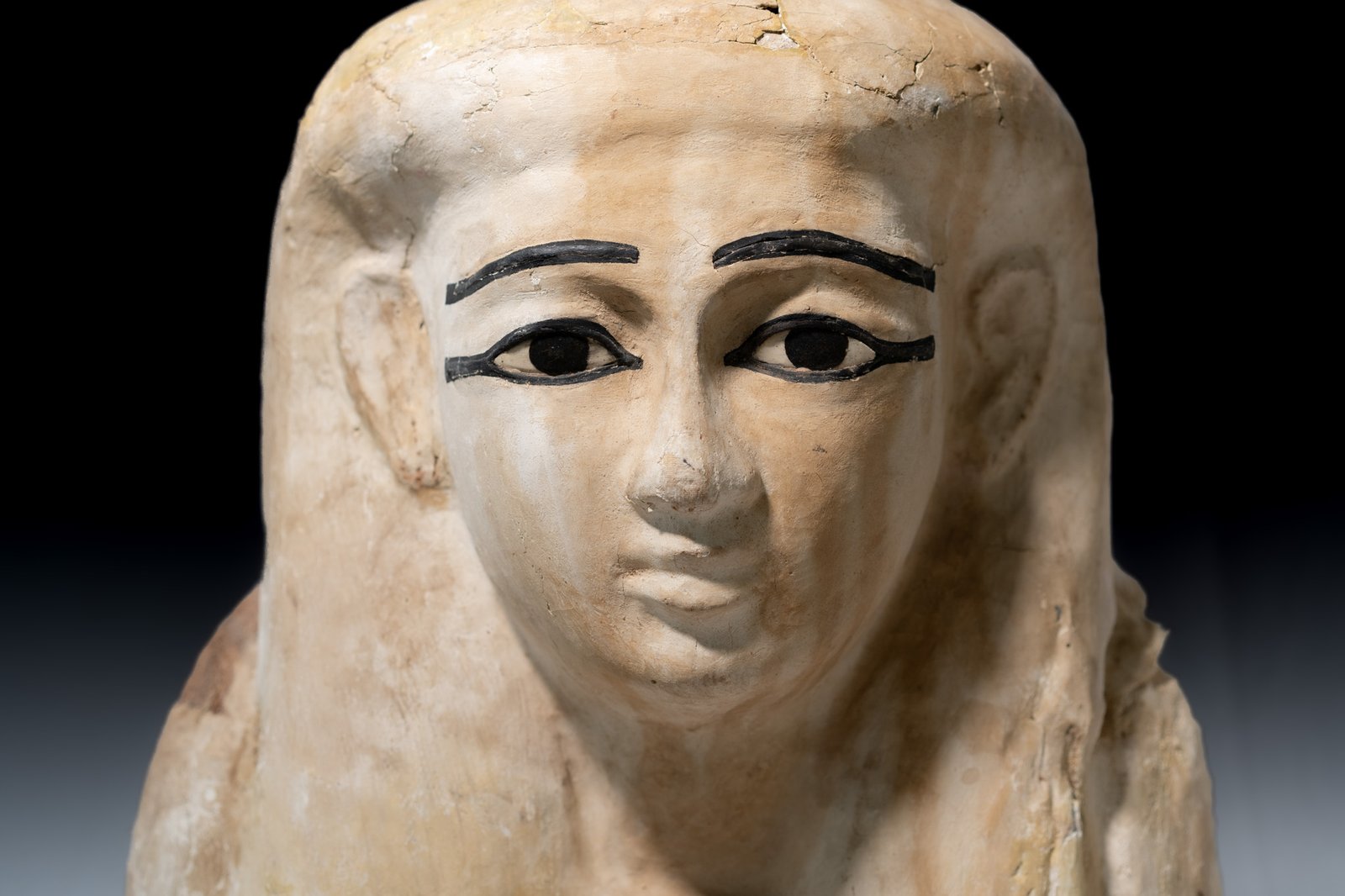
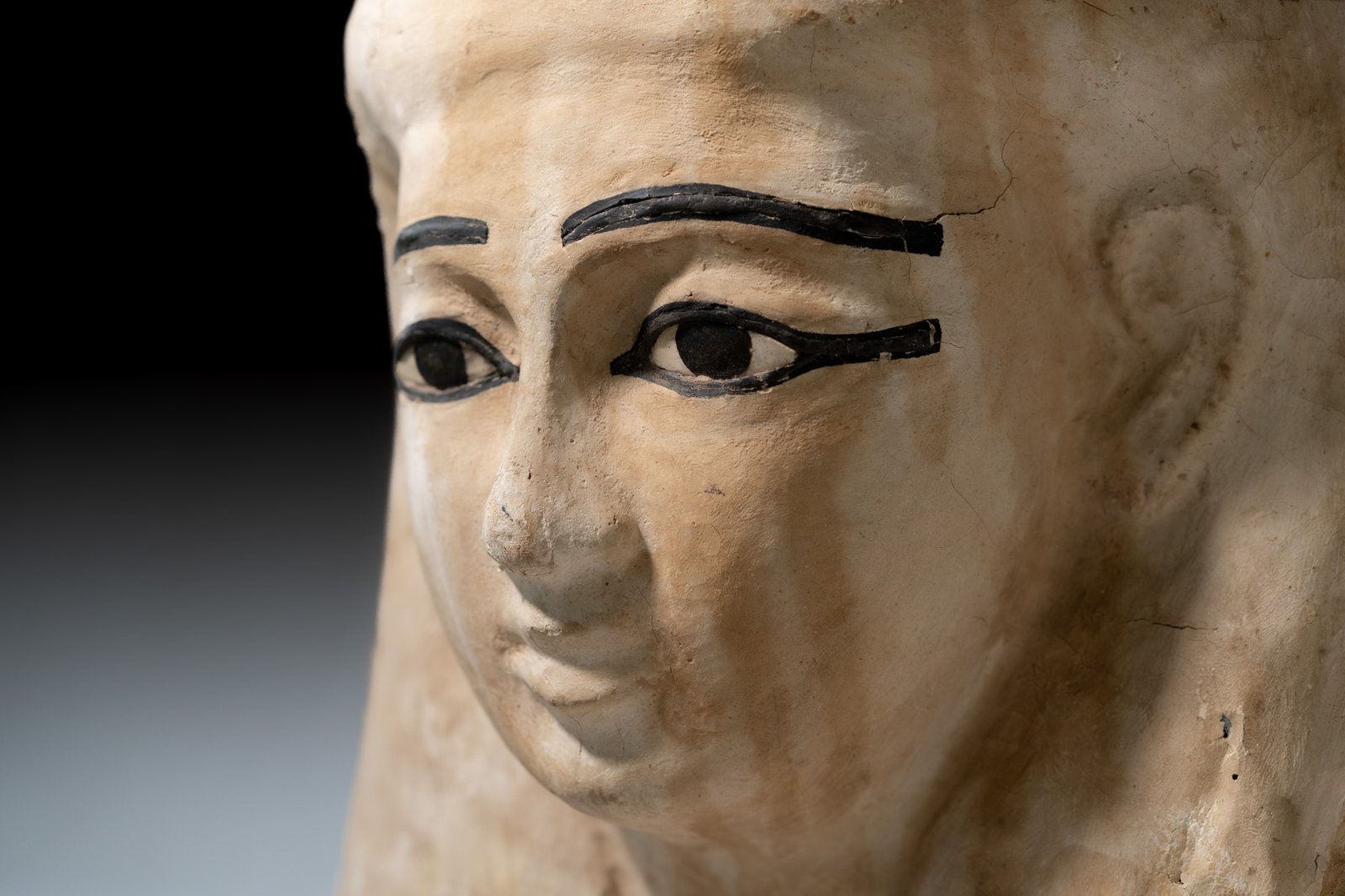
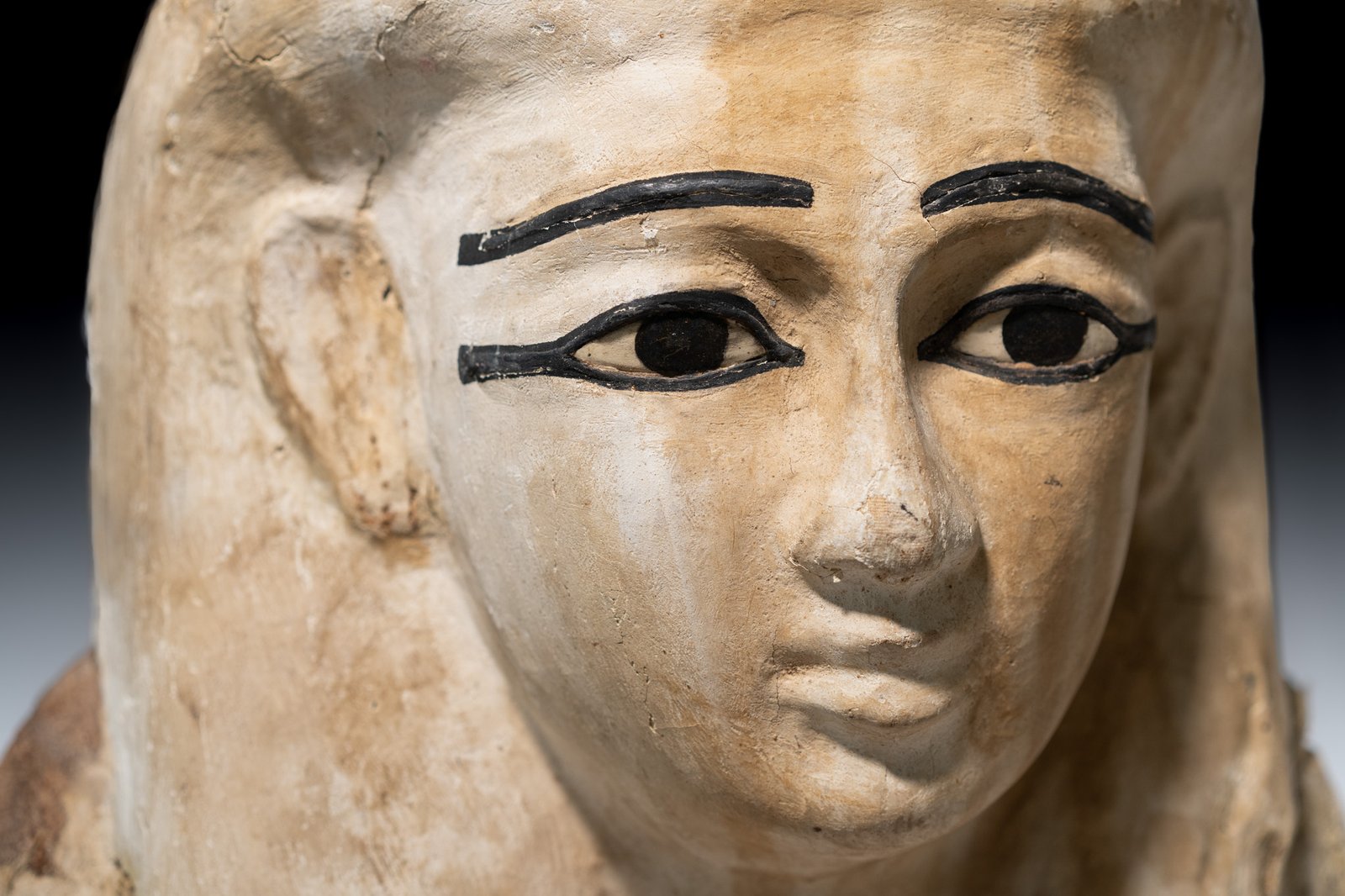
Egyptian wood funerary mask, Late Period, Circa 663-332 BC.
Conservation: Good state of conservation. Restoration work focused on consolidation and colour adjustment of the surface.
Material: Wood, stuccoed and painted white, inlaid eyes
Dimensions: 54 x 50 x 28 cm
Provenance: Former Rothgangel private collection, Munich, Germany, acquired in Egypt before 1976, then passed down to the current owner; Auction house, France, 2024
Published: E.S. Edwards, A Handbook to the Egyptian Mummies and Coffins, London 1938; Carol Andrews, Egyptian Mummies, London 1988; Expertise by Antonia Eberwein. Galerie Eberwein has been dedicated to the art of ancient Mediterranean civilizations for 40 years.
Impressive and skillfully carved upper section of a sarcophagus lid, depicting the face of a white-skinned man wearing a soft tripartite wig, with eyes and eyebrows inlaid with bronze and limestone and painted black. The ears, in accordance with Egyptian custom, appear larger than in real life and are designed to protrude from the tripartite headdress. The deceased appears beardless, but the absence of this attribute does not necessarily reflect a gender distinction, as anthropoid sarcophagi of the period, inscribed for men or women, often lack false beards.
During the Late Period (after 664 BC), the use of wood for statues and sarcophagi regained popularity, especially during the 20th Dynasty (380-342 BC) and the early Ptolemaic Period. The most exquisite set of coffins was discovered last century in the Tomb of Petosiris, a magnificently decorated temple-like tomb in Middle Egypt, near Ashmumein, in Tuna el-Gebel, where excavators discovered a multiple burial in an underground chamber.
The ancient Egyptians believed that it was extremely important to preserve the body of the deceased, as the soul needed a place to reside after death. Coffin lids such as the one in this example were created so that the soul could recognize the body and return to it. For this reason, these lids and the death masks placed underneath were made in the likeness of the deceased.