

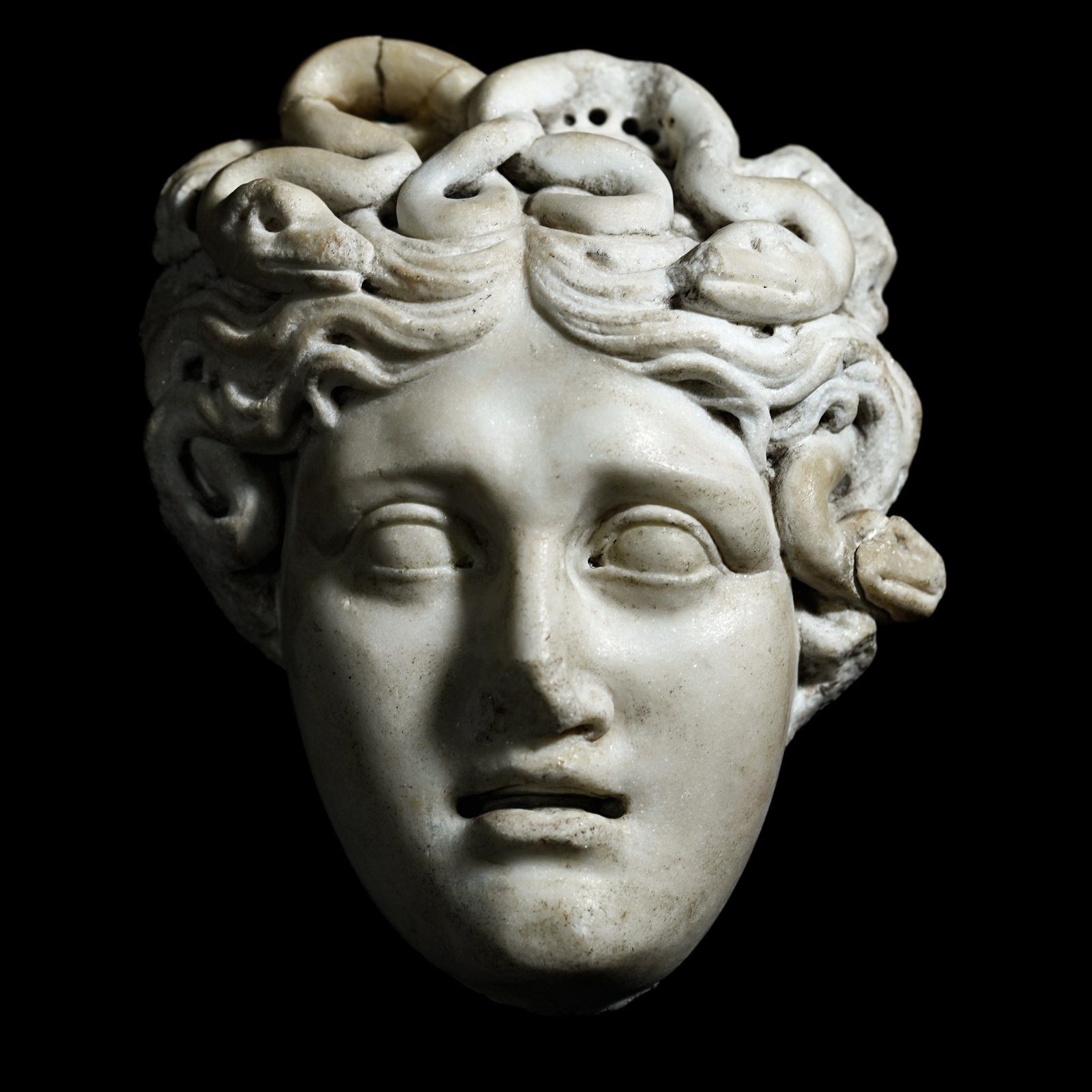
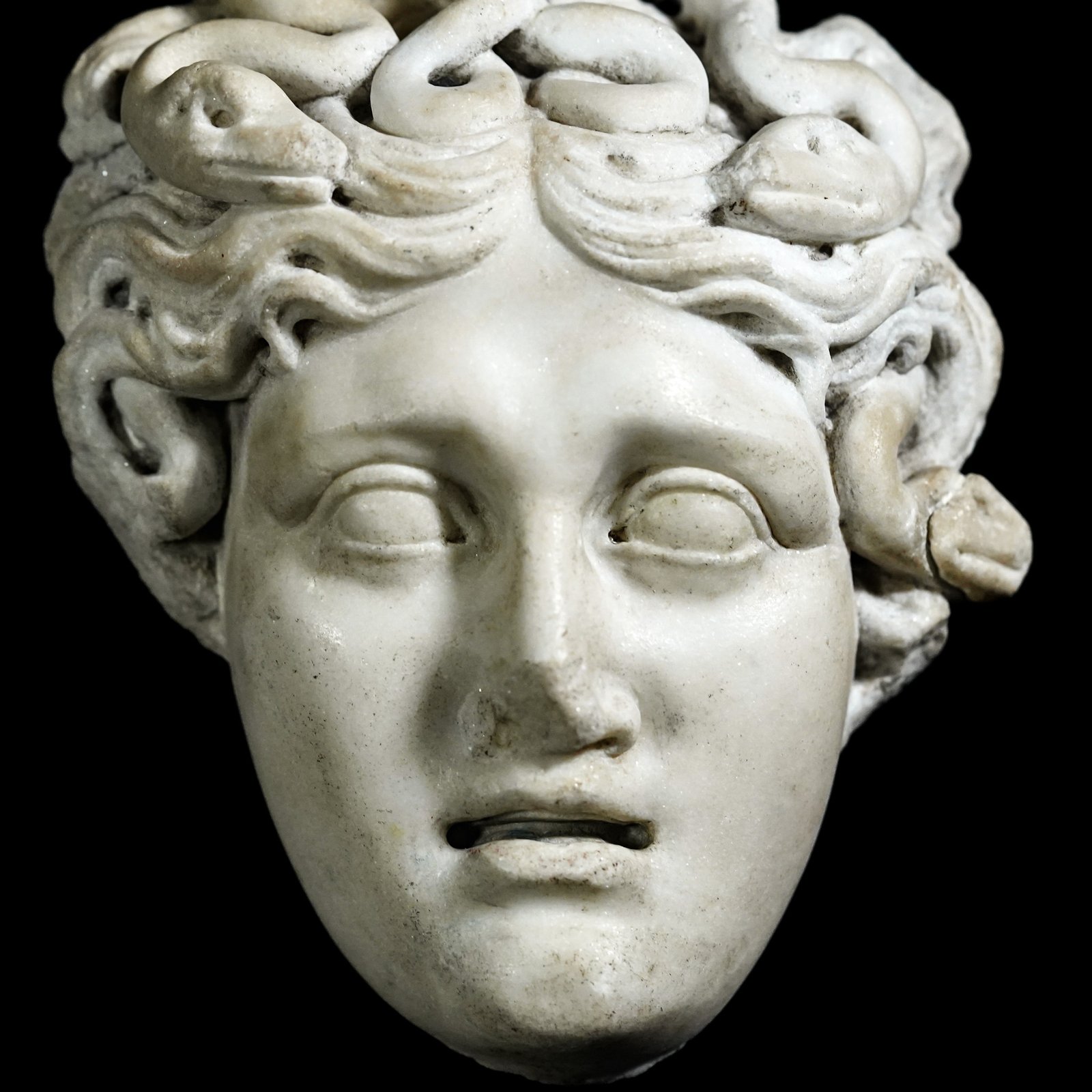
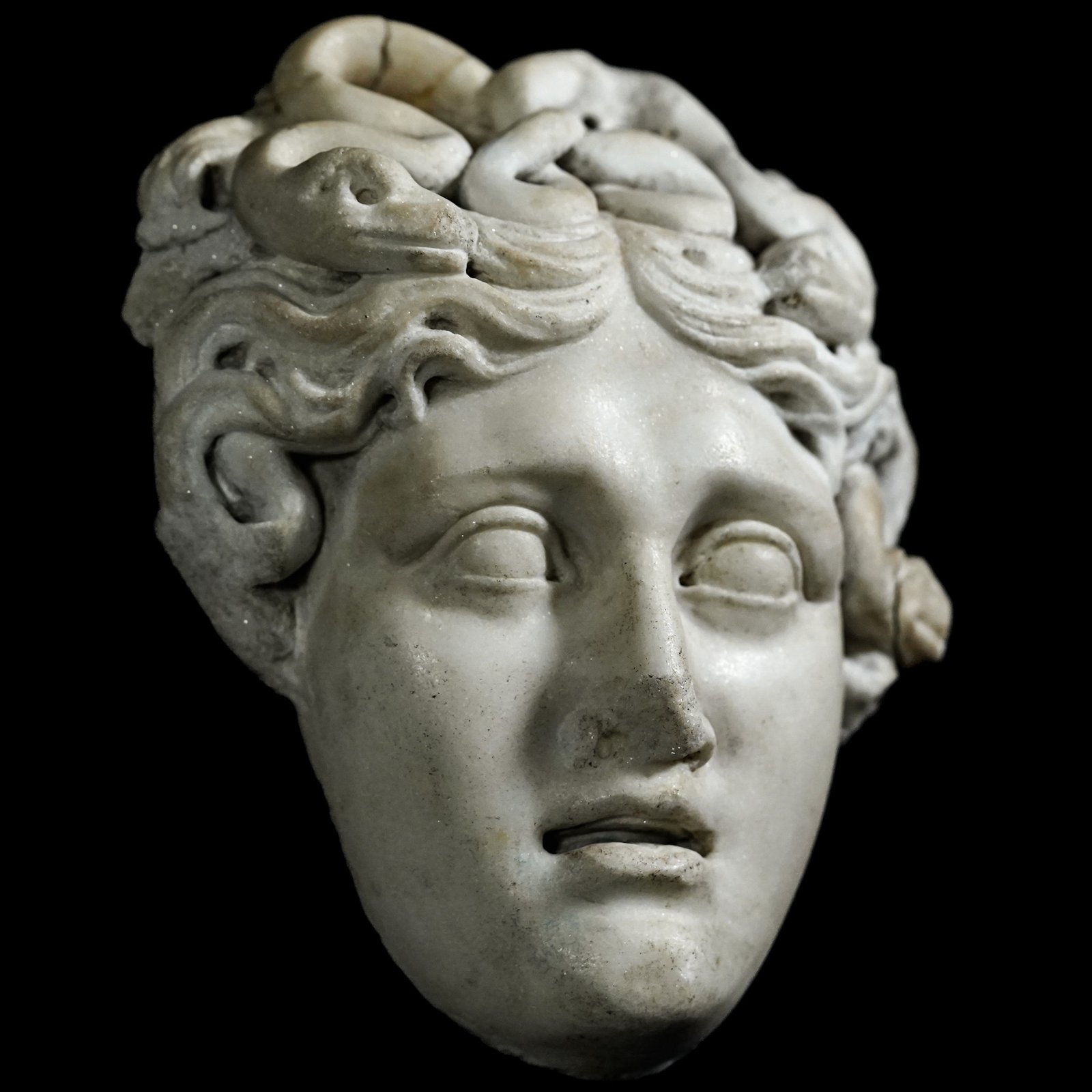


This piece must have originally been part of a larger sculptural program—probably integrated into an architectural relief, a pediment, or a decorative element of a protective nature—and later became a freestanding relief. The representation corresponds to Medusa, one of the three Gorgons of Greek mythology, a figure who achieved extraordinary iconographic fortune in both the Hellenic and Roman worlds.
Medusa embodies one of the most complex and ambiguous figures in the ancient imagination. In the most widespread mythical tradition, recorded in a particularly influential form by Ovid in Metamorphoses (IV, 770 ff.), she was not born a monster, but was originally a woman of great beauty, a priestess consecrated to Athena. Her beauty—especially her hair—was renowned. Her union with Poseidon in the temple of the goddess triggered her punishment: Athena transformed her hair into snakes and gave her gaze the power to petrify anyone who looked at her.
The story, far from being unambiguous, presents nuances depending on the ancient sources. In earlier versions by Ovid, Medusa appears as a monstrous creature from the outset. Ovid’s reinterpretation introduces a tragic and almost moralizing dimension, emphasizing the fragility of beauty and the implacable nature of divinity. This variant had an enormous impact on Roman culture, where the figure of Medusa took on psychological and dramatic connotations.
Medusa was the only mortal of the three Gorgon sisters—Sthenene, Euryale, and Medusa—which allowed her to be killed by Perseus. With the help of Athena and Hermes, the hero managed to behead her using the reflection of his shield to avoid her direct gaze. According to tradition, the winged horse Pegasus and the giant Chrysaor, children conceived with Poseidon, sprang from her severed neck. Even after her death, her head retained its petrifying power, becoming a fearsome weapon that Perseus used on several occasions before offering it to Athena, who incorporated it into her aegis as a protective emblem.
The figure of Medusa thus articulates multiple meanings: she is monster and victim, threat and amulet, punished beauty and invincible force. Her gaze, capable of turning into stone, symbolizes the boundary between life and death, movement and immobility, desire and destruction. In symbolic terms, petrification can be interpreted as a metaphor for paralysis in the face of the sacred or the forbidden; her head, separated from her body but still active, embodies the persistence of power beyond death.
In the Roman context, Medusa was not only a mythological motif, but also a symbol of protection and authority. Her image, integrated into architectural, domestic, or funerary contexts, acted as a symbolic guarantee against adverse forces. The permanence of the motif in imperial art reveals a fascination with this liminal figure, situated on the border between the human and the monstrous, between beauty and danger.
The piece presented here captures this ambivalent dimension. It is not simply the representation of a mythical episode, but the sculptural embodiment of a symbol deeply rooted in ancient Mediterranean culture, where myth, religion, and protective function converge in an image of powerful conceptual intensity.
Iconographic Evolution
This head of Medusa is part of the Hellenistic-Roman iconographic tradition that radically transformed the archaic representation of the Gorgon. In contrast to the primitive Greek model of the 7th–6th centuries BC, characterized by violent apotropaic features—bulging eyes, protruding tongue, visible fangs, intimidating frontal gesture—this sculpture adopts an idealized formal language, with classical roots and Hellenistic sensibility.
In the Archaic period, the gorgoneion served an eminently protective function: its deliberate ugliness and terrifying expression were intended to ward off evil. Paradigmatic examples of this type can be seen in architectural reliefs of Archaic temples and in Attic black-figure pottery, where the rigid frontality and expressive deformation emphasize its monstrous character.
However, from the 5th century BC onwards, and more evidently during the Hellenistic period (4th–2nd centuries BC), there was a gradual humanization of the myth. The Gorgon ceased to be represented exclusively as a hybrid creature and became a tragic and ambiguous figure. This process culminated in models such as the so-called “Medusa Rondanini” type, whose influence was decisive in imperial Roman sculpture. In these examples, the expression is softened, the features are harmonized according to classical canons, and the snakes are organically integrated into the hair, subordinate to the overall composition.
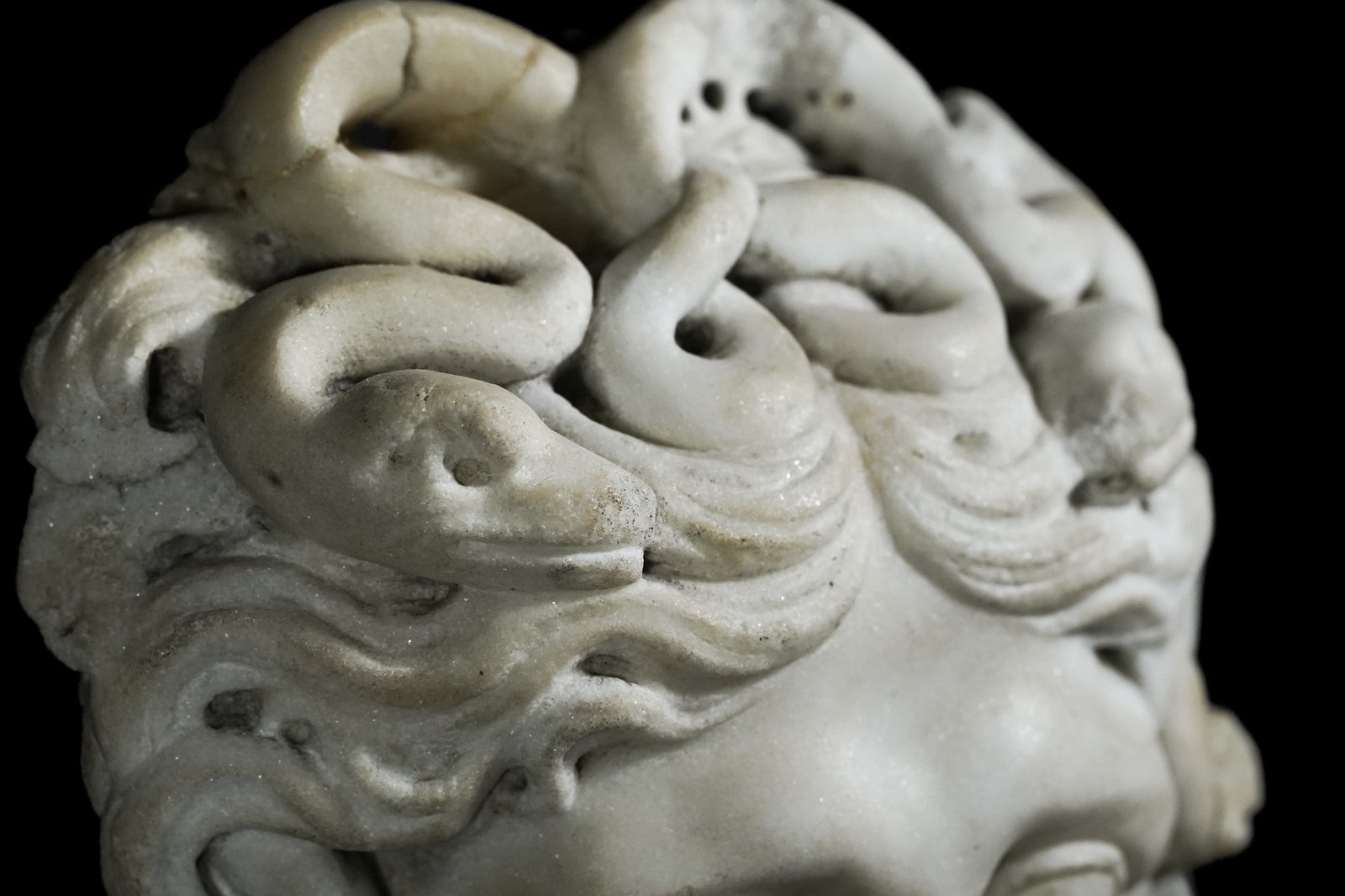
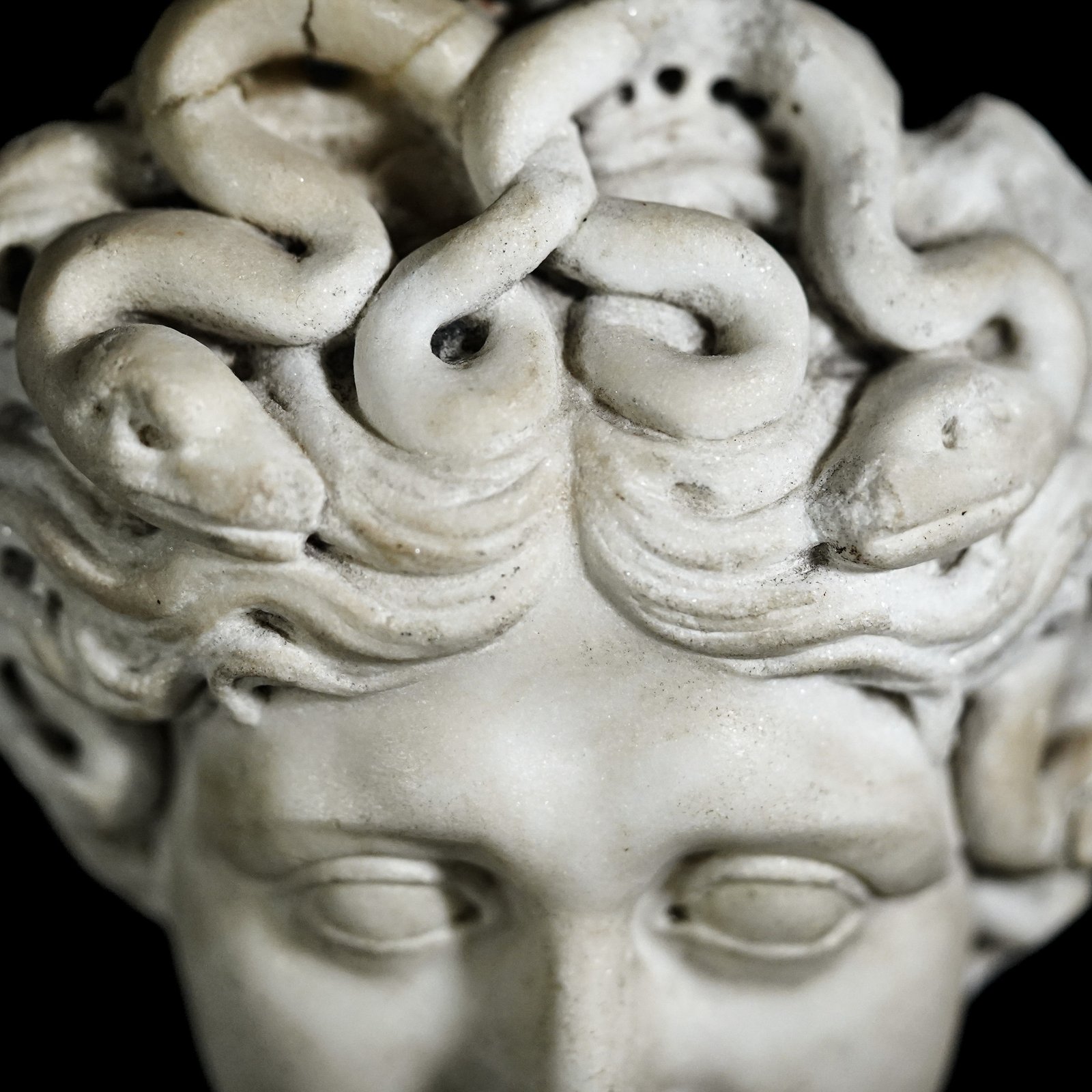
The piece studied here responds to this second iconographic paradigm. The face has an oval and proportionate structure, with soft cheekbones and continuous modeling; the eyelids are heavy and almond-shaped, generating an introspective rather than threatening gaze; the mouth, slightly ajar, suggests a suspended breath that replaces the aggressive gesture with contained tension. The snakes, far from bursting in violently, are treated as rhythmic elements of the hairstyle, blending with the undulations of the hair and adding dynamism without breaking the serenity of the whole.
This treatment responds to the imperial Roman taste for the aesthetic reinterpretation of Greek mythology. In decorative contexts—domestic, funerary, or architectural—the image of Medusa retains its apotropaic value, but is adapted to the classical ideals of beauty that dominate the sculptural repertoire of the 1st and 2nd centuries AD. Primitive monstrosity is transformed into tragic elegance; terror becomes solemnity.
From a stylistic point of view, the work participates in a synthesis between Hellenistic naturalism and idealizing Roman classicism. It is no longer a terrifying mask, but a female face of great formal dignity, whose beauty lies precisely in that tension between humanity and myth. This duality explains the persistence and popularity of the motif in Roman sculpture, where the figure of Medusa becomes a stylized and aesthetically refined protective symbol.
Similar items


